 nicos
GuideAndes & coffeeHuila
Tatacoa Desert and San Agustín: a road trip through Huila, Colombia
Short answer
The typical route starts in Neiva: from there it is about 45 minutes to Villavieja and another 15 to the Tatacoa, according to ProColombia. San Agustín is to the south, via Neiva or Pitalito. Its archaeological park has been a UNESCO World Heritage Site since 1995, and in 2026 entry costs COP 75,000 for foreigners and COP 50,000 for Colombians (ICANH).
- Tatacoa
- Tropical dry forest of about 330 km², not a desert (ProColombia)
- Neiva–Tatacoa
- About 45 min to Villavieja and 15 more to the desert
- Temperature in the Tatacoa
- Average of 28 °C; up to 40 °C on sunny days
- San Agustín
- UNESCO World Heritage Site since 1995
- 2026 entry, foreigners
- COP 75,000 (ICANH, Res. 1702 of 2025)
- 2026 entry, Colombians
- COP 50,000 general; COP 25,000 reduced
- Maintenance closure
- First Tuesday of each month (ICANH, 2026)
- Climate in San Agustín
- Cool, 18 °C on average (ProColombia)
How do you plan a Huila route with the Tatacoa and San Agustín?
The usual plan is to start in Neiva, go to the Tatacoa in the north of the department and then head down to San Agustín, in the south, via Pitalito.
- Neiva: ProColombia says the area is reached by road or by plane to Neiva or Pitalito from Bogotá, Cali and Medellín.
- Tatacoa: it is in Villavieja, in northern Huila, about 40 km from Neiva.
- San Agustín: it is in southern Huila. From Pitalito you continue by road to the town.
- Alto de los Ídolos and Alto de las Piedras: they are near Isnos, about 30 km from San Agustín, according to ProColombia.
We do not publish road times between Neiva and San Agustín or flight frequencies because we did not find an up-to-date official source. Your advisor confirms them according to the season.
How to get to the Tatacoa Desert
From Neiva: about 45 minutes by car to Villavieja and another 15 minutes to the desert, according to ProColombia.
Villavieja is the base town. It is home to the Paleontological Museum, with fossils of the fauna and flora that lived in the area millions of years ago.
What is the Tatacoa and what can you do there?
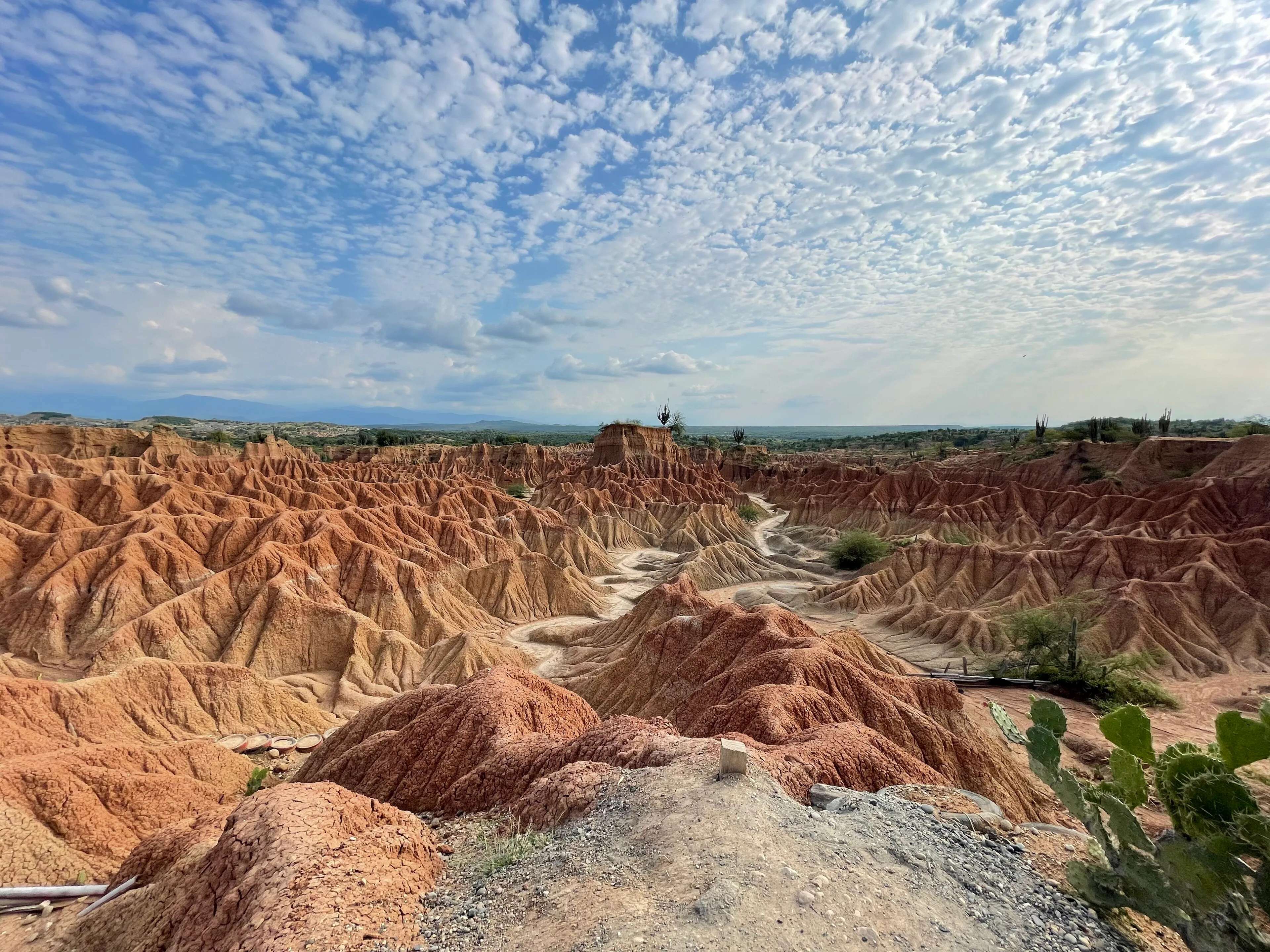
Although it is called a desert, ProColombia clarifies that it is a tropical dry forest: about 330 km² of gray, red and ochre gullies.
- Hike the two color zones: the ochre of El Cuzco and the gray of Los Hoyos.
- Stargazing: the Huila Governor's Office highlights its clear skies and low light pollution. Local observatories welcome visitors at night.
- See fossils: the Huila Governor's Office describes the area as an open-air museum, with rocks and fossils millions of years old, and says it was recognized as geological heritage by the International Union of Geological Sciences.
How hot does it get?
Very. ProColombia gives an average of 28 °C and up to 40 °C on sunny days. It recommends hiking with an organized tour and seeking shade. Bring water, a hat and sunscreen, and avoid hiking at midday.
What to see in San Agustín
The San Agustín Archaeological Park, with its stone statues and tombs, and the nearby sites around Isnos. UNESCO inscribed it as a World Heritage Site in 1995, and in 1993 it was declared a National Monument and National Archaeological Park.
- Inside the main park: the Forest of Statues (Bosque de las Estatuas) and Alto de Lavapatas.
- Near the town: El Tablón (3 km away), La Chaquira and the Magdalena Strait, where the river narrows.
- Toward Isnos: Alto de los Ídolos and Alto de las Piedras.
- Obando: about 15 km away, with funerary urns, according to ProColombia.
The climate is cool: ProColombia gives an average of 18 °C. Bring a light jacket even if you are coming from the Tatacoa heat.
How much is entry to the San Agustín Archaeological Park in 2026?
COP 75,000 for foreigners and COP 50,000 for Colombians and resident foreigners, according to ICANH Resolution 1702 of 2025, in force since January 1, 2026.
- Reduced fee: COP 25,000 for students and children aged 6 to 11, among others.
- Free: children under 5 and Colombians or residents over 62.
- These fees apply to the San Agustín and Ídolos archaeological parks. Your advisor confirms whether your package already includes entry.
Which days is the park closed?
According to ICANH, the park closes on the first Tuesday of each month for maintenance (Resolution 0568 of 2026). ProColombia, on an undated page, says it closes every Tuesday and opens from 8:00 a.m. to 3:00 p.m. The official sources do not agree: ICANH sets closures and opening hours each semester, and your advisor confirms them before the trip.
What health and safety precautions should you take in Huila?
Get the yellow fever vaccine at least 10 days before and check travel advisories if you are continuing on to Cauca.
- Yellow fever: Colombia is under a health emergency for yellow fever. According to Ministry of Health Circular 001 of 2026, Huila is among the departments with confirmed cases between 2024 and January 2026. The Ministry of Health recommends getting vaccinated at least 10 days before traveling to risk areas.
- Travel advisories: Huila does not appear in the restrictions of Canada (September 29, 2026) or the United Kingdom (September 23, 2026).
- If you continue on to Cauca: Canada advises avoiding all travel to Cauca except the city of Popayán, and the United Kingdom advises against all but essential travel to all of Cauca except Popayán. Your advisor tells you which way each transfer goes.
This guide does not replace medical advice.
How we made this guide
Written by @adondevaruben for Amazónicos Viajes y Aventuras based on official sources checked on October 3, 2026: ProColombia, the Huila Governor's Office, UNESCO, ICANH, the Ministry of Health and the Canadian and UK travel advisories.
Information changes. We review this guide every 3 months and at the start of each season, and your advisor confirms requirements and costs before every trip.
Frequently asked questions
How do I get to the Tatacoa Desert from Neiva?
By road: about 45 minutes to Villavieja and 15 more minutes to the desert, according to ProColombia.
Is the Tatacoa a real desert?
No. ProColombia clarifies that it is a tropical dry forest of about 330 km², with ochre (El Cuzco) and gray (Los Hoyos) zones.
How much does a foreigner pay to enter the San Agustín park?
COP 75,000 in 2026, according to ICANH Resolution 1702 of 2025. Colombians pay COP 50,000.
Is the San Agustín Archaeological Park open on Tuesdays?
It depends. ICANH closes it on the first Tuesday of each month for maintenance, and ProColombia says it closes every Tuesday. Confirm the date before you go.
Do I need the yellow fever vaccine to visit Huila?
It is recommended. Huila had confirmed cases between 2024 and January 2026, according to the Ministry of Health, which asks travelers to get vaccinated at least 10 days before. Ask your doctor.
How hot is the Tatacoa?
On average 28 °C and up to 40 °C on sunny days, according to ProColombia. Hike early or late in the afternoon.
Sources
- ProColombia (Colombia Travel) — Tatacoa Desert, a land of stillness and curious landscapes (checked on Sat, Oct 3, 2026)
- Gobernación del Huila — El Desierto de la Tatacoa, un destino que enamora a turistas del mundo (29 de agosto de 2024) (checked on Sat, Oct 3, 2026)
- UNESCO World Heritage Centre — San Agustín Archaeological Park (checked on Sat, Oct 3, 2026)
- ICANH — Resolución 1702 de 2025 (tarifas 2026 de los parques arqueológicos de San Agustín e Ídolos) (checked on Sat, Oct 3, 2026)
- ICANH — Resolución 0568 de 2026 (cierres del Parque Arqueológico de San Agustín) (checked on Sat, Oct 3, 2026)
- ProColombia (Colombia Travel) — Visita San Agustín, la capital arqueológica de Colombia (checked on Sat, Oct 3, 2026)
- Ministerio de Salud — Circular Externa 001 de 2026 (fiebre amarilla) (checked on Sat, Oct 3, 2026)
- Ministerio de Salud — Fiebre amarilla (vacunarse al menos 10 días antes) (checked on Sat, Oct 3, 2026)
- Gobierno de Canadá — Travel advice and advisories: Colombia (actualizada el 29 de septiembre de 2026) (checked on Sat, Oct 3, 2026)
- Reino Unido, FCDO — Colombia: warnings and insurance (actualizada el 23 de septiembre de 2026) (checked on Sat, Oct 3, 2026)
Photo credits: Catalina · CC BY-SA 4.0 · Wikimedia Commons